-
Rendering 2.0,
-
Privacy policy for users,
-
OpenJupyter integration,
-
AI-powered metadata suggestions,
-
Storybook for layouts,
-
Theme pages,
-
System-wide maintenance notifications
We would like to thank edu-sharing e.V. and metaVentis GmbH for funding this update.
auf dieser Seite:
Engine replacement
With this release, we have modernised a key part of the system’s technical infrastructure. In doing so, we have completely moved away from the previous Solr search technology and fundamentally overhauled the architecture. At the same time, key core components have been updated – including Alfresco from 23.4 to 25.2, Angular from version 16 to 19, and PostgreSQL 16. The container architecture has also been revised and further improved. The result is a more modern, easier-to-maintain and future-proof system foundation.

Rendering 2.0
With version 10.0, we are introducing a new generation of our rendering service. The new version has a fully modular architecture, is horizontally scalable, and is designed to run across multiple instances. Technically, it is based on modern components such as Spring Boot/Kotlin, RabbitMQ, MongoDB and S3-compatible storage with RustFS, and integrates the frontend as an Angular library (Web Components) for flexible integration into the layout. In version 10.0, Rendering 2.0 can be activated as an option; from version 11.0 onwards, it will become a standard component of the system.

GDPR – Data Subject Access Request for Users
This feature allows users to request a full copy of the personal data stored in the system. The information can be provided either as a clear report (PDF) or as structured data output. Both metadata and – if requested – the associated original files (binaries) are included. In this way, the system helps organisations to efficiently meet the GDPR’s requirements regarding transparency and data access.

OpenJupyter (Proof of Concept)
With OpenJupyter, we are testing the integration of Jupyter Notebooks into edu-sharing. Jupyter is a widely used environment in research and higher education for combining code, data analysis, visualisations and explanatory text in interactive documents. In this proof of concept, GitHub projects can be created as link objects in edu-sharing and rendered in an interactive notebook environment. This allows reproducible analyses, programming exercises or data-based teaching materials to be used directly from within the platform.
For further development, we are seeking industry partners from the higher education sector, particularly those with experience in operating secure Jupyter infrastructures and in matters of IT security and platform operations.

AI-powered metadata suggestions
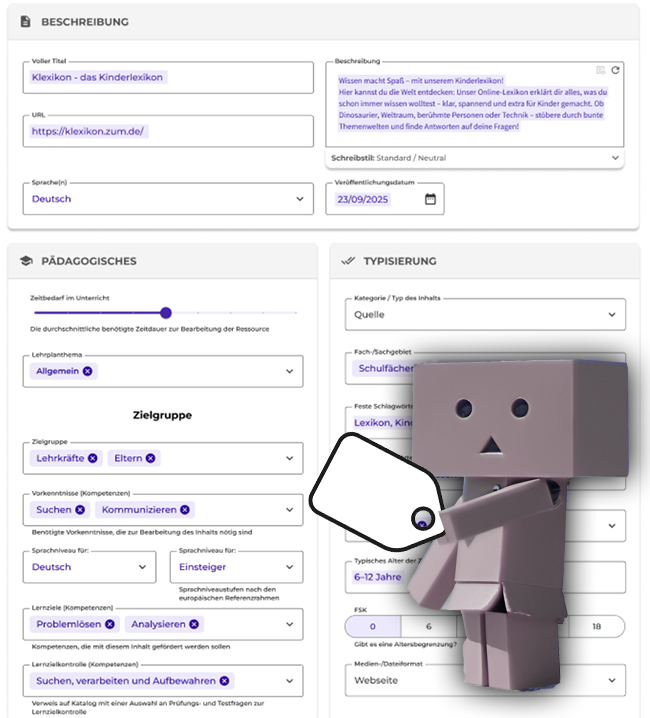
This feature helps users describe materials using automatically generated metadata. When uploading content, analysis services can be integrated to suggest appropriate keywords, topics or classifications. A central backend API manages AI access and controls communication with various analysis services. The generated suggestions are stored in a suggestion database and can be directly incorporated into the metadata of the materials.
Storybook for layouts and UI components
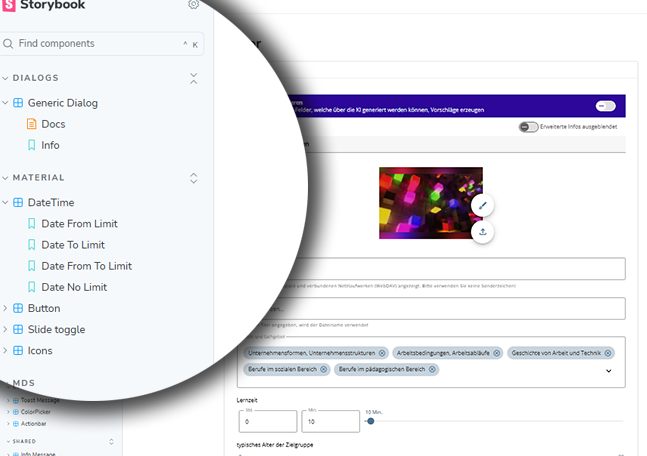
Storybook has been introduced as a centralised working environment for layouts and UI components. This allows individual components and complete layout modules to be visualised, tested and further developed independently of the overall system. Mock-up testing facilitates coordination with UX and improves the testability of new interfaces at an early stage. In addition, Storybook supports the verification of colour schemes, accessibility and the consistent use of the component library.
Subject pages – widgets as a modular system
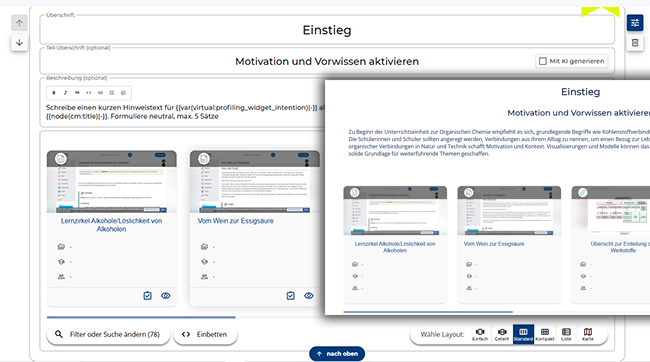
With the new subject pages, content can be flexibly organised using a modular system. Various widgets – such as content lists or individual previews – can be freely configured and combined. The system is complemented by WYSIWYG elements, which allow curated content to be designed directly. AI-generated content can also be integrated and subsequently edited. This results in customisable pages for the clear presentation of content.
System-wide maintenance notifications
Administrators can now set up scheduled system notifications – for example, regarding planned maintenance windows or current service restrictions.
Both the display format and the restriction to specific areas – for example, the search function only – are possible.